The end of the year is when many micro-entrepreneurs ask themselves: should I stay as a micro-entrepreneur next year, or move to something else? You might be getting close to the turnover threshold, you might have signed a couple of big contracts for next year, or your expenses might feel too high and you'd like to claim them back.
In this article, I look at the facts to help you decide: the 4 reasons to leave the micro-entrepreneur, the legal structures you could move to, and the timescales and process to switch.
Reason 1: You're going over the turnover threshold
As a micro-entrepreneur, there is a maximum turnover you can cash in each year. It depends on your activity. Here are the thresholds for 2026 to 2028:
| Activity | Maximum per year (HT) |
|---|---|
| Activité libérale Consultants, coaches, teachers, programmers |
83,600 € |
| Activité artisanale Builders, photographers, beauty, jewellery makers |
83,600 € |
| Location meublée classée Classified gîtes, Airbnb |
83,600 €* |
| Activité commerciale Shops, food stalls, markets, e-commerce |
203,100 € |
* Non-classified gîtes are limited to 15,000 €.
Watch out if you created your business in 2025 or earlier: the thresholds were different then.
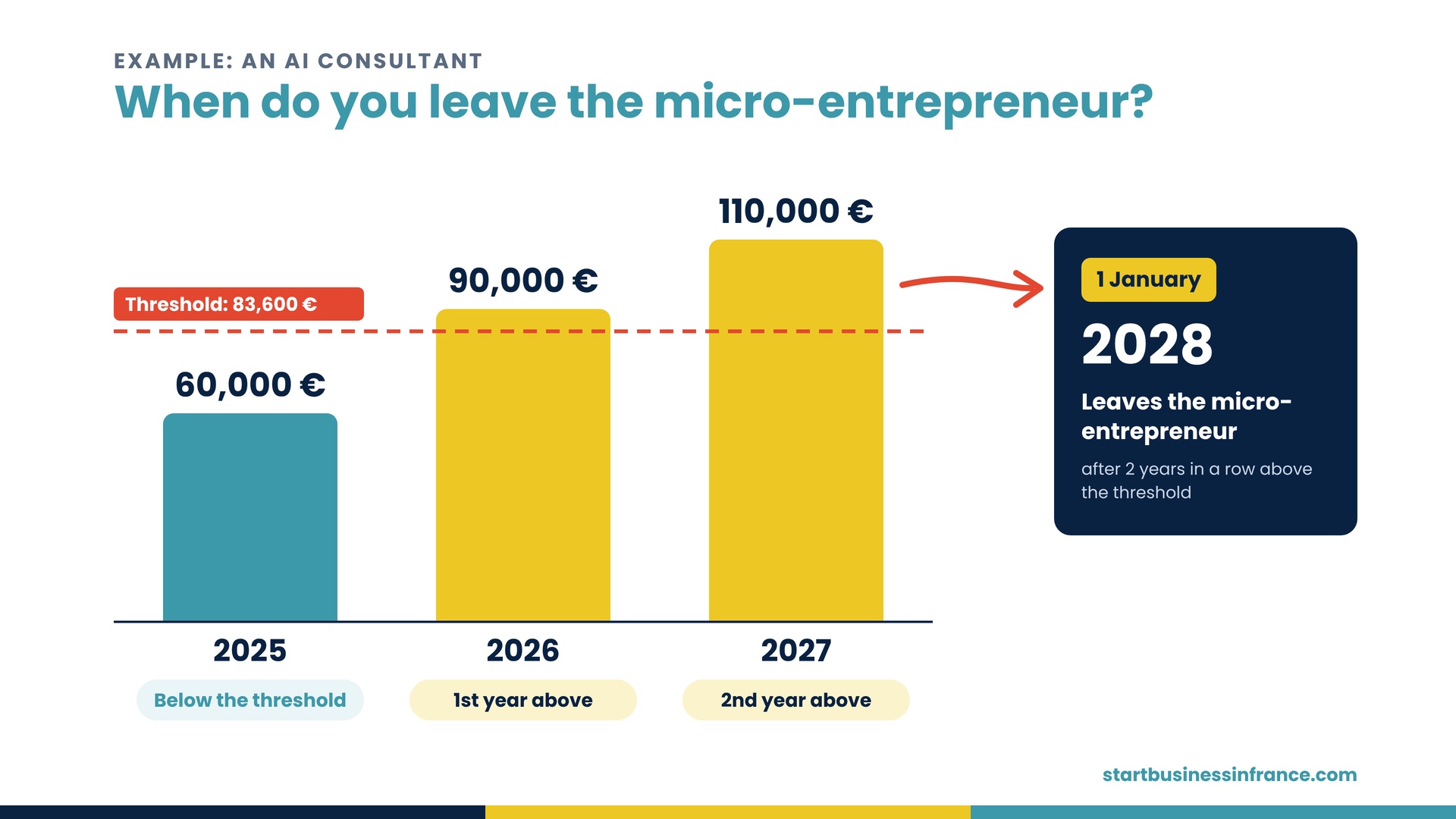
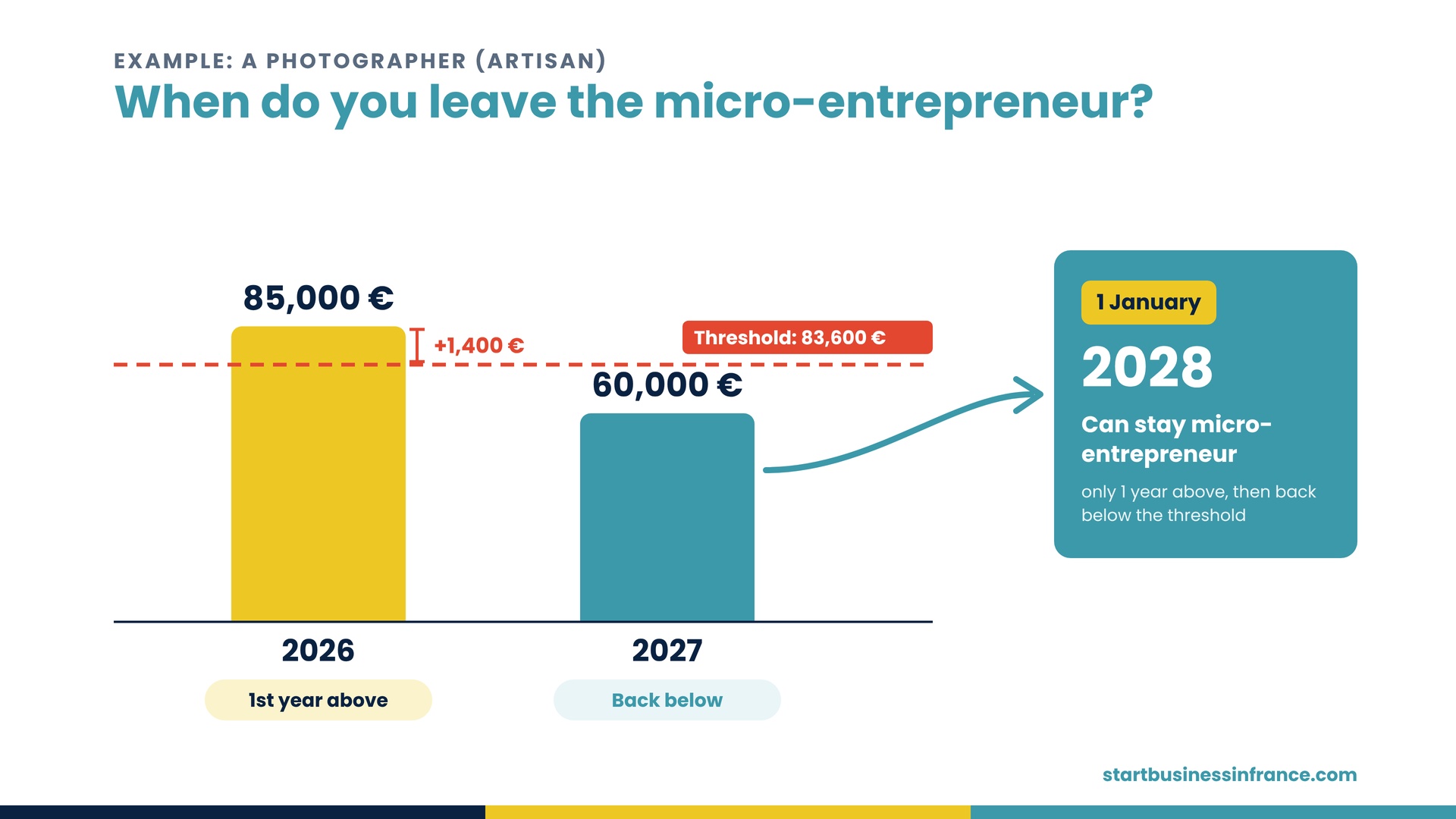
What most people don't know is that you can go over the threshold for two years in a row before you have to leave the micro-entrepreneur. You then come out of the micro regime on 1 January of the following year.
Example 1: an AI consultant. In 2025 he makes 60,000 €, below the threshold. In 2026 he makes 90,000 €: his first year above. In 2027 he makes 110,000 €: his second year above. He leaves the micro-entrepreneur on 1 January 2028.
Example 2: a photographer. In 2026 she makes 85,000 €: her first year above. In 2027 she makes 60,000 €, back below the threshold. She went above for one year only, so she can stay a micro-entrepreneur.
It's up to you. You might stay over the threshold for two years because it suits you, or because it makes your visa renewal easier. Or you might leave sooner because your expenses are too high, which brings us to reason 2.
Reason 2: Your expenses are too high
I often hear: "It's a shame, with the micro-entrepreneur I can't claim anything back." Here is something most people don't know, and it will help you decide whether your expenses really are a problem.
As a micro-entrepreneur, you pay social charges as a fixed percentage of your turnover:
| Activity | Social charges 2026 | Standard rebate |
|---|---|---|
| Activité libérale Consultants, coaches |
25.6% | 34% |
| Activité artisanale Photographers, builders, beauty |
21.2% | 50% |
| Activité commerciale E-commerce, shops, buying to resell |
12.3% | 71% |
When these rates were set, the average running costs of each type of activity were taken into account. You only see this when you do your income tax, or talk to an accountant or a bank manager. To work out your income from the business, they apply a standard rebate (abattement forfaitaire): 34% for consultants, 50% for artisans and 71% for buying to resell. That percentage is assumed to cover both your social charges and your business expenses.
So here is the exercise I recommend:
- Add up your business expenses for the year: accountant, liability insurance, software, training, travel for work, equipment.
- Add your social charges.
- Divide the total by your turnover to get a percentage.
- Compare it with the standard rebate for your activity.
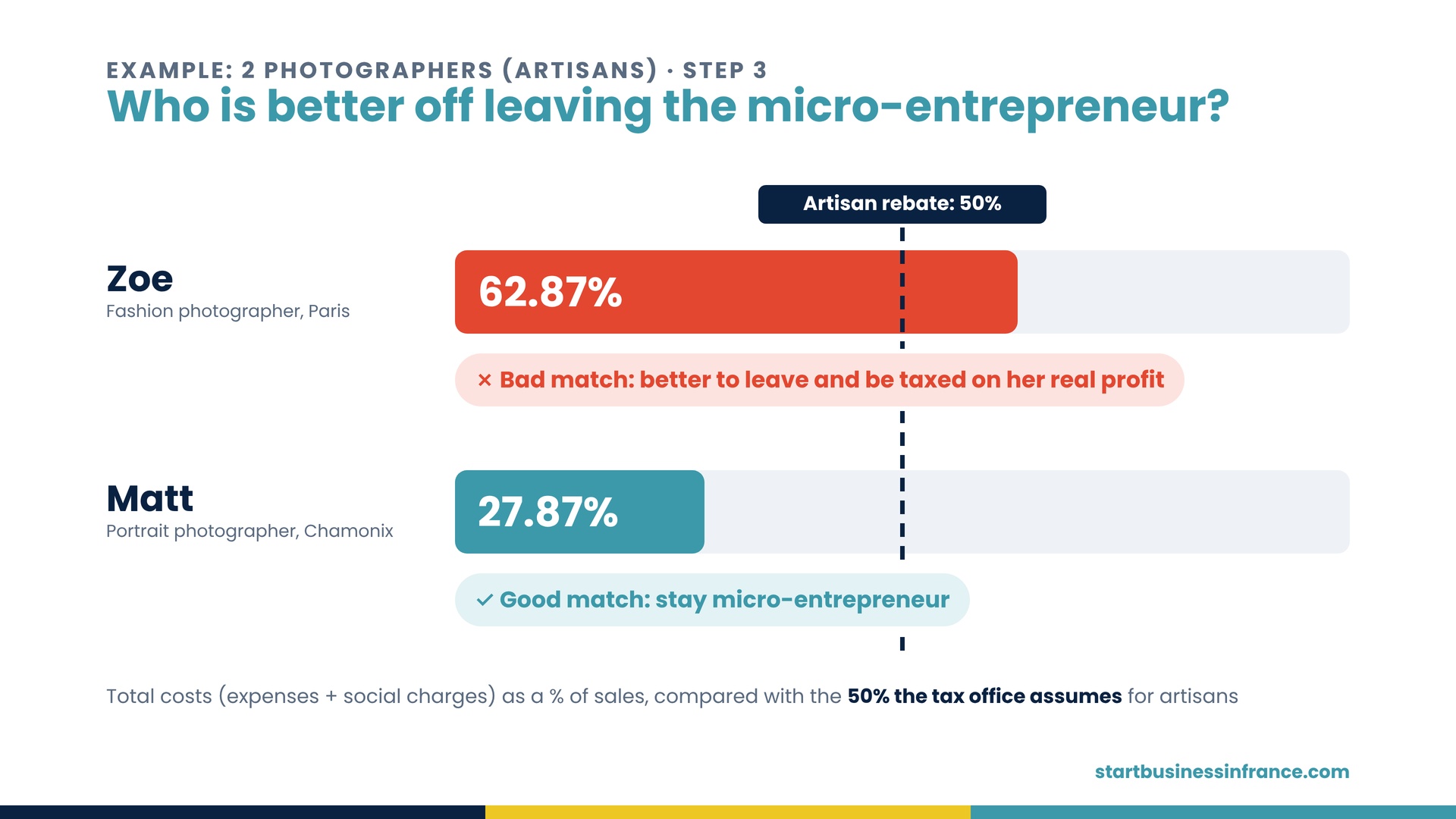
Example: two photographers with the same turnover. Zoe is a fashion photographer in Paris. She travels, flies to shoots and hires assistants. Matt is a portrait photographer in Chamonix who takes family photos outdoors. (I made these numbers up, so photographers, don't get cross!)
| Zoe Fashion, Paris |
Matt Portraits, Chamonix |
|
|---|---|---|
| Sales | 60,000 € | 60,000 € |
| Fixed expenses | 25,000 € | 4,000 € |
| Social charges (21.2%) | 12,720 € | 12,720 € |
| Total costs | 37,720 € | 16,720 € |
| % of sales | 62.87% | 27.87% |
As artisans, both are assumed to spend 50% of their turnover on expenses and social charges. Matt is at 27.87%: the micro-entrepreneur is a great match for him, because the rebate is bigger than his real costs. Zoe is at 62.87%: it's a bad match. She would be better off with a regime where she can claim back all her expenses, depreciate her equipment and be taxed on her real profit.
If you're just a couple of points above the rebate (say 35 or 36% as a consultant), it's no big deal, especially if next year is uncertain. If you're at 40 or 45%, it's time to switch.
Reason 3: Liability
A micro-entrepreneur is a sole proprietor: there is no legal distinction between you and your business. If the business runs up debts, you are liable for them.
For most activities this isn't a real issue, especially with a liability insurance. But if you own property or other assets you want to protect, and your turnover keeps growing, it may be time to move to a company. Ask yourself: is my sector risky? Is there a risk of clients not paying? Could a client sue me, for example if I work with US customers?
Reason 4: Your business is growing
You might want to go into business with someone else, which means changing your legal structure. Or you might want your spouse to become a full partner in the business. Your spouse can join a micro-entrepreneur as a conjoint collaborateur, but only for five years. A SARL or SAS lets you bring a partner into the business properly.
Which structure after the micro-entrepreneur?
1. Stay an entreprise individuelle, at the régime réel simplifié
You keep the same business and the same SIRET number: you just switch tax regime. You're taxed on your profit, so you can claim back your expenses and depreciate your equipment. This works well for activities that are growing steadily but not hugely, such as photographers or therapists.
2. EURL or SARL
An EURL has one partner (you stay on your own). A SARL has two or more. You're taxed on profit, you can deduct expenses and depreciate equipment, and you can choose corporation tax or income tax. It also protects your personal assets. Dividends above 10% of your share capital are subject to social charges, so don't count on them.
This works well for activities with high expenses, equipment to depreciate or employees: cafés and restaurants, the food industry, hospitality, gîtes and retreats. The idea is a modest margin that you keep reinvesting to reduce the profit you're taxed on.
3. SAS or SASU
This is the closest to a UK Ltd, a US LLC or a South African Pty. You pay yourself through a mix of salary and dividends. Remember that French salaries are expensive, with employee and employer social charges on top. Dividends are paid once a year, after the financial year closes and your accountant has done the accounts (around two months), and you can't take them in advance.
If you're on a business visa, make sure you pay yourself a proper salary. Some people try to be tax-efficient with hardly any salary and only dividends, but at your visa renewal it looks as if you have no income below the French minimum wage (SMIC), and that's a big issue.
The SAS/SASU works well for high-margin activities with a high turnover and long-term stability, such as consultants and programmers. My rule of thumb: don't consider it until you reach around 110,000 € of turnover.
When and how to switch
Switching to the réel simplifié: you keep your business and your SIRET number. Look at your numbers in October, November or December, then tell the tax office through your impots.gouv professional account, and URSSAF too, so the switch applies from 1 January. Your social charges will then be paid differently, on a different website. Check the exact deadline with your accountant.
Moving to a company (EURL, SARL, SAS, SASU): you can switch at any time of the year. Plan at least two months ahead so you have time to get advice from a couple of accountants and run some simulations.
You have two options for your existing micro-entrepreneur business:
- Bring it into the new company. If you've been trading for a few years, with a regular turnover, a brand and a customer base, an accountant can value your business so you bring it into the company's share capital. They charge a fee for this.
- Close it and start the company. You time the closure with the new company starting, so you can keep working without a break.
Creating the company itself usually takes 2 to 3 weeks, because you go back and forth between your accountant and your bank:
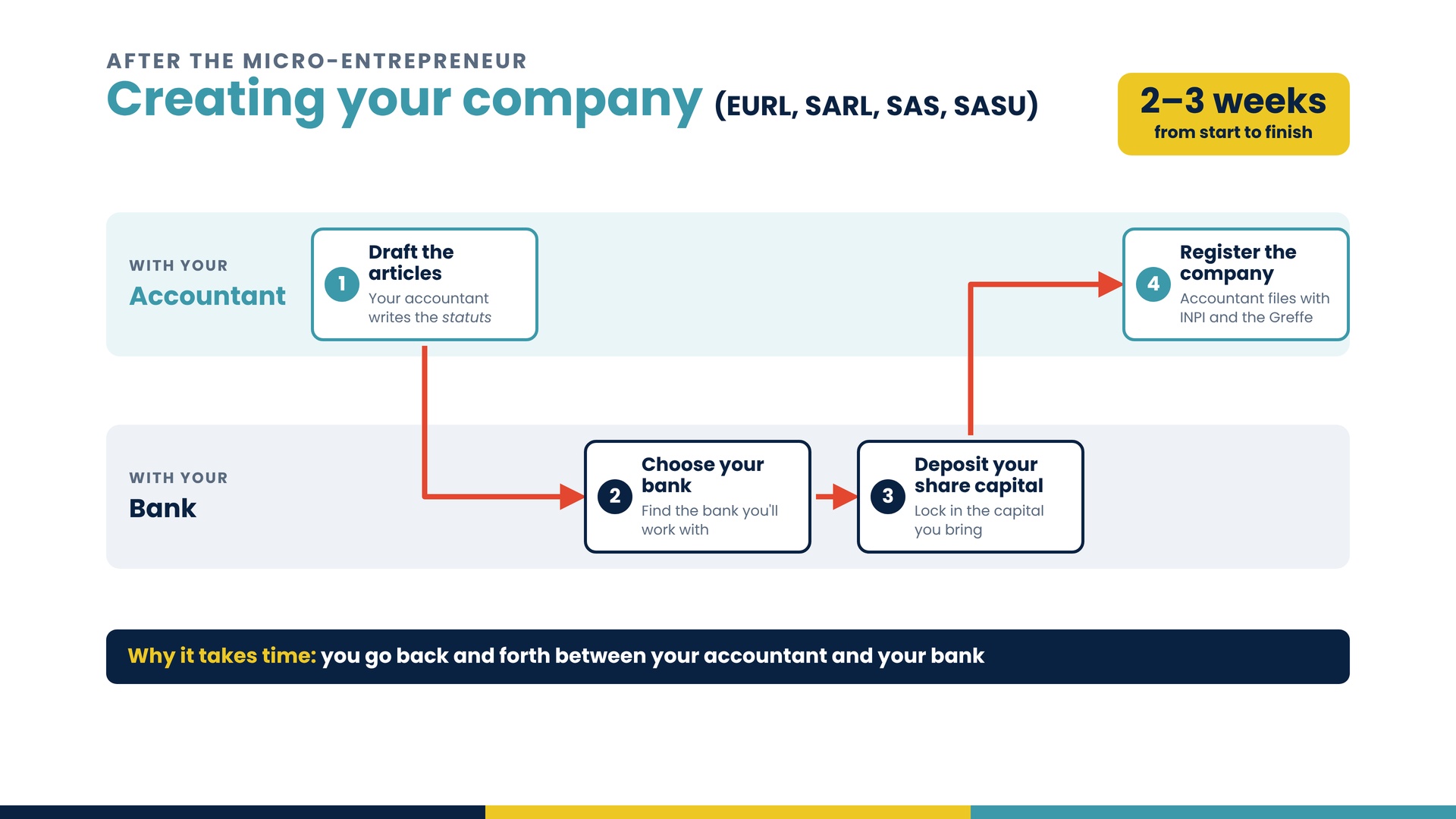
Some online services offer to do this for you with an online bank. My advice: don't try to save on the registration. It's usually best to have the accountant who will manage your business register it too. They'll advise you on corporation tax or income tax, SARL or SAS, and when your financial year should end. Once the business is set up, it's too late, or it costs more to fix.
Need help deciding?
If you'd like to look at this for your own activity, book a Power Hour with me and bring your numbers. We'll work out together whether it's time to leave or whether you're fine as you are, and I can introduce you to an accountant for the next step. Often people are relieved to find their current set-up is fine for another couple of years.
